Friday, May 08, 2015

London Entrepreneur Launches ‘the Uber of Premium Finance’


London, 13 May 2015 – CEO Bundeep Singh Rangar today announced the launch of PremFina (www.premfina.com) – a new player bringing innovation to the traditional UK premium finance market with its white-label premium finance solution. PremFina’s solution means better returns, better retention and greater autonomy for insurance brokers, and it is coming to BIBA 2015 to show them what they’ve been missing out.

PremFina takes premium finance to the next level. It transforms the rigid model adopted by the competition, which sees brokers facilitating rather than managing the issuance of premium finance agreements, using inflexible software and making small referral fees, by providing them instead with their own-branded premium finance facility. PremFina’s white-label solution offers brokers a combination of market-leading software to manage the sale of broker-branded insurance policies to consumers and businesses as well as the financing to enable their customers to pay policy premiums via monthly instalment plans. This means brokers get to keep everything in-house.

Because every industry needs its Uber. PremFina, like Uber, is in the business of changing how things are done by cutting out the middleman, with its disruptive technology. Uber has done it for taxi drivers with their ‘tech startup meets taxi service’ mobile app, giving drivers a platform for accelerating their business by connecting them with the customers directly. PremFina has done it with its premium finance solution that makes insurance brokers more ‘freelance’ by saving them from a hand over of their customer relationship to the financing company.

Like Uber, PremFina takes things up a notch with easy to use, flexible software that tracks the progress of customer journey, has options at every price and for different needs. All this translates into the highest standard customer service. Let’s face it, that’s what it’s all about.

With PremFina, you Give Premium, and Get Premium. That’s right. Our solution gives brokers the ability to brand, set market relevant prices, a bigger interest-based fee and an opportunity to maintain customer touchpoints to upsell and cross sell. It essentially puts the brokers in better control of their business.

“We’re really excited to be going to BIBA this year. It couldn’t be a better timing for us with PremFina launching just in time for the event“ said CEO Bundeep Singh Rangar. “If you want to have a drink and a chat about what we do, or just want to say hi, we’ll be at stand C58.”

The BIBA conference is a flagship event for the UK insurance industry. It offers invaluable networking opportunities and a programme of inspirational keynote speakers, senior industry personalities and experts in insurance and general business related fields. 


Saturday, February 28, 2015

New India Budget Aims to Boost Growth


IndusView, Saturday 28 February 2015 (London): Asia’s third-largest economy unveiled its annual budget today saying it is aimed at a high-growth trajectory. The budget is focusing on improving infrastructure, cutting the fiscal deficit and boosting investment so that growth would accelerate to 8%-8.5% in India’s next financial year starting in April.

“The budget gives an opportunity to the increasingly young, middle-class and aspirational India to realize its full potential,” said Bundeep Singh Rangar, Chairman of London-based consulting firm IndusView. “The time was ripe for long-awaited reforms to kickstart the economy.”

Presenting the budget in parliament Mr. Jaitley said the country was growing at a strong rate, inflation was down and foreign exchange reserves were high. Falling global oil prices have given the government the room to spend on creating infrastructure without increasing inflation or messing with fiscal deficit targets.

He further announced a panoply of economic and tax reforms and promised $11.36 billions of dollars of investment towards infrastructure. Five ultra-mega power projects of 4,000 MW capacity each are planned. The government will introduce tax-free infrastructure bonds for road, rail and irrigation projects. The focus will be on additional road and ports projects.

To the delight of business, Mr. Jaitley said a nationwide general sales tax (GST) system – “a state-of-the-art indirect tax system” – would be put in place by April 1 next year, replacing a jumble of local fees and taxes that prevent India from being a single market for goods and services.

“This is not a ‘big-bang’ budget, but a good budget more focused on smaller issues, and ironing out a lot of irritants to investors in the process,” said Rangar. “Neither the financial markets, nor most analysts, detected the dramatic reforms that Mr. Modi’s supporters have been urging.”

Manmohan Singh, who served as India’s prime minister for 10 years under the Congress Party, faulted the budget as too cautious, arguing that the new government had missed a chance to cut spending or increase tax revenues.
Corporate taxes, meanwhile, will drop from 30% to 25%, which could increase Indian firms’ compliance.

This is a positive budget for the Private Equity (PE) industry as it addresses some of the key pain points of the industry. The removal of distinction between FPI and FDI is welcome as it is not really possible to differentiate between the two and has caused delayed response from investors. Foreign Investment is now allowed in alternative investment funds, which will stimulate the environment of foreign investment and private equity interest in India.

There are 200 plus active fund managers operate in India while 100 are domestic fund managers. The PE industry claims over 12% employment growth in PE/Venture Capital (VC) backed companies against 3% employment growth in non PE-backed companies.

Modi didn’t take further steps today to wind up fertilizer, cooking gas and liquid petroleum gas subsidies. Jaitley repeated pledges to provide homes, toilets and electricity for India’s 1.2 billion people by 2022, which would be the 75th anniversary of the country’s founding.

India’s economy is projected to expand as much as 8.5% in the next fiscal year, according to the latest Finance Ministry estimates, the fastest pace among the world’s biggest emerging markets. The ministry cautioned, however, that the forecast is based on a revised method for calculating gross domestic product and India’s economy is still recovering.

Friday, February 27, 2015

India’s 2015 Union Budget Expected to Boost Annual GDP Growth to 8% from 6.9%


IndusView, Friday 27 February 2015 (London): The new Indian government will unveil more reforms in its 2015-2016 Union Budget on Saturday, to woo foreign investment and make India a manufacturing destination, in order to boost Gross Domestic Product (GDP) growth to 8% or higher. Mumbai’s stock exchanges, that have seen its benchmark Sensex index rise about 20% since Prime Minister Narendra Modi came to power last May, will exceptionally be open on Saturday.

The Modi government’s “Make in India” initiative is being closely followed by Indian companies and foreign investors. A lot of hope rests on the new government’s first full-year budget following its victory in last year’s general election.

The announcements to be made by Finance Minister Arun Jaitley will impact the investment cycle that the world’s tenth largest economy needs to lift GDP growth to an expected revised target of 8% or more from current projections of 7.4% in the current fiscal year 2015-16. India grew 6.9% in its previous fiscal year.

“Foreign investment and better collection of taxes is needed to fund the $1 trillion requirement outlined by Prime Minister Modi to build the country’s infrastructure over the next five years,” said Bundeep Singh Rangar, Chairman of London-based advisory firm IndusView. “Better infrastructure is pivotal to increase India’s GDP as it will shear waste and inefficiencies in agricultural and industrial output. Widening its direct tax base beyond the current 3.3% of India’s population that pay tax and increasing the 15.5% contribution of tax to GDP is critical.”

India recently announcement investment plans of about $137 billion to upgrade its rail network. The state-owned Indian Railways operates one of the world's largest railway networks comprising 115,000 km of track that carry more than 13 million passengers a day and 1 billion tons of freight annually generating more than $26 billion in annual revenue.

Most corporate leaders and economists believe that there could be no better time to push through the reform agenda than now, given that the macroeconomic scenario has largely turned favorable, with inflation showing signs of coming under control, oil prices declining and growth in some of the more significant global economies showing signs of serious slowdown.

India's Wholesale Price Index (WPI) fell for the second time in three months in January as oil prices slumped, bolstering prospects for further interest rate cuts by the Reserve Bank of India (RBI) that unexpectedly cut rates for the first time in two years in January. WPI unexpectedly fell 0.39% last month from the same period a year earlier, its biggest decline since June 2009.

India's Current Account Deficit (CAD) is estimated to come down to 1.3% of GDP in the fiscal ending March, helped by moderation in petroleum and gold imports that were significantly lower than earlier projections.

“The new government is committed to development with transparency and good governance,” said Rangar. “A number of reforms have been implemented, paricularly via ordinances and more changes are expected to be announced in the upcoming budget announcement.”

To attract foreign investments, the government should best amend its controversial tax law and not impose tax with retrospective effect on overseas deals involving local assets.

“The Indian tax man’s potential treatment of low cost intellectual capital work allocated by India to multinationals, as being a higher value service and therefore, taxable at higher rates, will give reason to multinationals to seek other jurisdictions where taxation is simpler and the cost advantages are as good, if not better than India,” said Rangar. “The tax man should focus its efforts to widen the tax base and harmonsing its Goods and Services Tax and thereby, increase revenue.”

India, currently the world’s tenth-largest economy, is vying to be among the top five by 2022, according to the London-based Centre for Economics and Business Research (CEBR).

Monday, February 09, 2015

M&A Deals Jumps to 1,177 in 2014


India saw a merger and acquisition boom in 2014. The total number of M&A deals of Indian companies in 2014 rose to 1,177 the highest ever in a decade and the momentum is set to pick up this year as well, said a report by London-based advisory company IndusView on Friday. M&A deals contributed close to $38 billion from 573 deals and PE deals contributed $12 billion from 604 deals, according to report by advisory firm Grant Thornton. E-commerce within IT space was the major contributor for PE investments with about $4 billion being raised from over 100 deals.
“Last year’s deal value at $50 billion has been a fantastic year for deal making with a very strong foreign investor interest in India,” said Bundeep Singh Rangar, chairman IndusView. “It is expected that 2015 deal-making will grow higher”.
Domestic M&A deals are riding on the consolidation wave with Sun Pharma acquiring Ranbaxy, Kotak merging with ING Vysya and others, it said.

Thursday, January 15, 2015

Inflation Drop Leads to Unscheduled India Rate Cut


IndusView, Thursday 15 January 2015 (London): The Reserve Bank of India (RBI) today pared its repurchase rate by 25 basis points to 7.75% from the current 8%, citing easing inflationary pressures.

In an announcement before the stock markets opened for trading, the central bank said inflationary pressures have been easing since July and the path of inflation has been below the expected trajectory.

“Oil importing countries like India, China, Brazil, Turkey, Indonesia and South Africa will be the big winners as oil prices continue to weaken in 2015,” said Bundeep Singh Rangar, Chairman on London-based consulting firm IndusView. “What is critical is for nations to use this window to usher in fiscal and structural reforms, which can boost long-run growth and inclusive development.”

India imports 85% of its crude oil requirement. Net oil imports at $95 billion accounted for 21% of India's total import bill and 64% of the trade deficit in 2014.

In the accompanying policy statement, the RBI mentioned that inflation momentum has significantly reduced and household inflation expectations have eased to single digit for the first time since September 2009. 

On the inflation outlook, the central bank said "on current policy settings, inflation is likely to be below 6% by January 2016". In the December policy statement the RBI had guided for a change in the monetary policy stance in early 2015, including outside the policy review cycle, if inflation data was supportive.

Making a decisive push towards generating investment to see the success of his 'Make in India' mantra, Prime Minister Narendra Modi said his government was trying to revive the economy, and told global investors that India today was a land of opportunities.

Mr Rangar recently attended The Vibrant Gujarat 2015, where Prime Minister Modi was addressing the seventh edition of the Summit. Modi laid down his government's plan and effort to create a policy environment that is predictable, transparent and fair.

By contrast with India, South Korea’s central bank chief today signaled he’s unwilling to reduce borrowing costs in response to an inflation rate pulled down in part by the slide in oil. Governor Lee Ju Yeol said the current interest rate of 2% is “not insufficient to support growth” and that the central bank will set future inflation targets soon.

The rate cut is a change in monetary policy stance and comes a few weeks earlier than expected due to the sharp fall in commodity prices and the better-than-expected December inflation print.  Bloomberg’s Commodity Index is down nearly 28% since its 2014 peak in May, and 43% since its 2011 peak.

Rajan’s move today will spur commercial banks to lower lending rates for borrowers, K. Subrahmanyam, executive director at state-run Union Bank of India in Mumbai, said in a phone interview. State Bank of India, the country’s largest bank by assets, has left its base rate at 10 percent since November 2013.


Tuesday, December 02, 2014

Reserve Bank of India Ignores Oil Price Drop; Maintains Interest Rate


IndusView, Tuesday 2 December 2014 (London): The Reserve Bank of India (RBI) left its benchmark rate unchanged at 8.00% Tuesday, failing to take advantage of the drop in international crude oil prices and the resulting deflationary effect on India’s biggest import item.

The India crude basket, computed by the petroleum planning and analysis cell, was $72.51 per barrel on November 27 compared with $90.50 per barrel on October 9. The Indian basket of crude oil is based on the weighted average of Middle East sour grades (Dubai and Oman) and the North Sea Brent sweet grade of London.

Despite the lower oil price, RBI Governor Raghuram Rajan said he was still awaiting more proof that inflation was under control.

“Lower oil prices keeps inflation low and could have served as a cue for the RBI to reduce interest rates and foster GDP growth,” said Bundeep Singh Rangar, Chairman of London-based consulting firm IndusView. “It increases prospects of the Narendra Modi government meeting its fiscal deficit target for 2014-2015. A lower RBI rate would have helped ensure it also meets its GDP growth target.“

India imports more than two-thirds of its oil requirements, which constitutes 37% of total imports. A one-dollar fall in the price of oil saves the country about $648 million. Every $10 a barrel fall in prices lowers retail inflation by 0.2 of a percentage point and wholesale inflation by half a point, experts estimate. Lower oil prices, therefore, have a three-fold effect spread across the economy.

Cheaper energy moderates inflation, which has already fallen from over 10% in early 2013 to 6.5%, bringing it within the central bank’s informal target range. This should lead to lower interest rates, boosting investment.

Cheaper oil also cuts India’s budget deficit, now representing 4.5% of GDP, by reducing fuel and fertilizer subsidies: along with food subsidies, the total is $41 billion in the year ending March 2015—14% of public spending and 2.5% of GDP.

The government controls the price of diesel and compensates sellers for their losses. But, for the first time in years, sellers are making a profit. As in China, cheaper oil should reduce the pain of cutting subsidies. Since Oct. this year, India has ended diesel price subsides and raised the price of natural gas.

Gross domestic product expanded 5.3% in the July-September quarter from a year earlier, as a manufacturing slump took the bounce out of Asia’s third-largest economy. Growth in the previous quarter was at 5.7%. 
Thanks to growth in services and stronger-than-expected farming after a bad monsoon, the reading was higher than predicted by economists polled by Reuters, who on average forecast growth of 5.1%. On a year-on-year basis, trade deficit increased by 28.1 per cent during Q2 FY 15 (Jul-Sep) as compared with a decline of 24.1% in Q1 of 2014-2015.

Prime Minister Modi is keen to promote India as an investment destination. Moves are afoot to schedule Prime Minister Narendra Modi’s first bilateral visit to the United Kingdom for an event on January 30, the death anniversary of Mahatma Gandhi. The trip will be his first bilateral visit to Europe. U.S. President Obama is also due to visit to India as Chief Guest of its Republic Day parade on Jan. 26.

Monday, September 29, 2014

Indian PM Modi Could Learn From US Economic Recovery While In US


IndusView, Monday September 29 (London): While the United States Federal Reserve Bank (Fed) is expected to raise interest rates in Spring 2015, the Reserve Bank of India (RBI) is likely to maintain them in order to battle un-simmering inflation.

The world’s largest economy registered an annualized growth of 4% in the second quarter 2014, beating expectations of 3.1% and confirming its recovery is back on track. The U.S. central bank has kept America’s short-term interest rates near zero since the end of 2008, as it battled to fuel growth after the financial crisis. A rise next year would represent the first rate increase in more than eight years; the last increase occurred in June 2006.

In India, industrial growth, which had revived in the April-June quarter and grew by 4.2%, slipped in July to a mere 0.5% for want of stimulus. The only sector that performed well was power generation with an increase by 11.2% year-on-year (y-o-y). Capital goods and durable consumer goods have underperformed, indicating weak demand. Inflation going by the wholesale price index dropped to 3.7% – its lowest in five years – but inflation at the retail level remained high at 7.8%.

“Prime Minister Modi could learn a lesson or two from the U.S. economic revival,” said Bundeep Singh Rangar, Chairman of London-based consulting firm IndusView. “India still needs to boost growth while the U.S. economy seems back on track.”

The U.S. is the only ‘superpower’ in the world today, with almost nine times India’s GDP and with a per-capita 33 times more than India’s. The U.S. is also the best example of the power of entrepreneurship enhancing prosperity of its people.

Modi will attend the United Nations General Assembly session in New York and then fly to Washington DC for the meeting with Obama at the White House on September 30. In his invitation letter, President Obama reiterated his invitation — that first came in a phone conversation with Modi on May 16 — and resolved to work closely with Modi to make India-U.S. relations “a defining partnership for the 21st Century”.

Modi, who was denied visa by the U.S. in 2005 due to the Gujarat riots, said he was of the view that “re-energizing the partnership between India and the U.S. would send an important message to the region and beyond”. Modi was Chief Minister of the State of Gujarat when violence against its minority Muslim population resulted in the deaths of 790 Muslims and 254 Hindus. 

“The U.S. and India have always been unfriendly friends. Now is the time to make themselves friendlier,” said Rangar. “From energy, to defense, to counter-terrorism, to trade, America and India have many overlapping national interests and need to strengthen their relationship to realize their efforts to collaborate.”

The U.S. Senate passed a unanimous resolution designating Sept. 30 as U.S-India Partnership Day. The resolution emphasizes the mutual benefits of a thriving U.S-India partnership, stressing the importance of increasing collaboration in order to promote stability, democracy, and economic prosperity in the 21st century.

Thursday, September 11, 2014

Wednesday, September 03, 2014

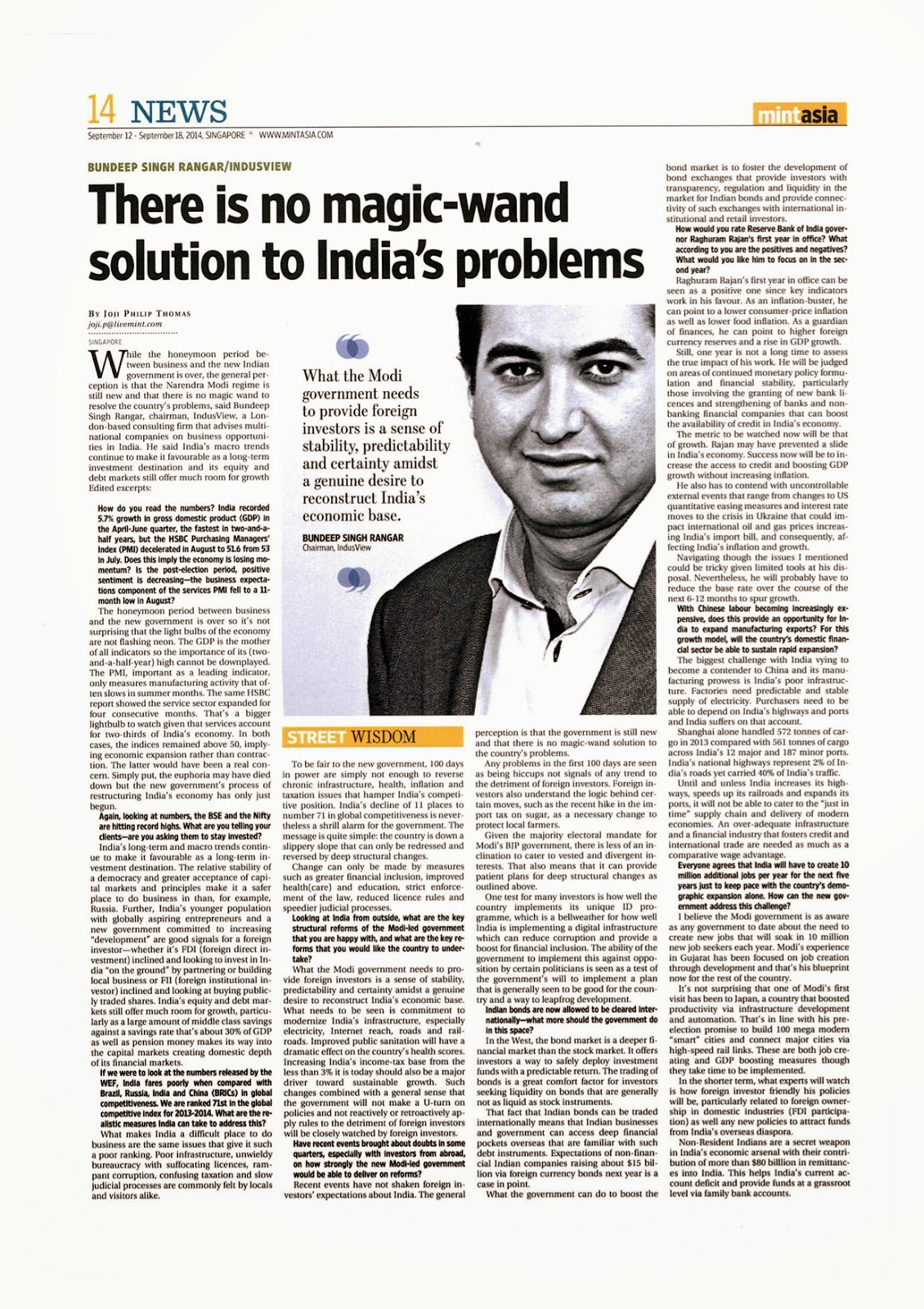
India PM Modi’s 100 Days in Office: Kaizen Not Magic Wand

IndusView, Wednesday 3 September 2014 (London): A visit to Japan is perhaps the best statement of Narendra Modi’s 100 days as Prime Minister of India, a honeymoon time typically used by new governments to push symbolic and substantive changes capitalising on voter sentiment that ushered them into power.

Accompanied by some of India’s top business leaders, Modi wooed Japanese corporate investors and promised Japanese Kaizen management style, noted for rigour and efficiency, in his own bureau, the Prime Minister’s Office.

For those expecting a shimmery display of new reforms, there was little to cheer. But for those awaiting deeper structural changes, the effects of which would be felt over months and years but not necessarily within 100 days, numerous observations were to be made.

“Modi is managing expectations against a magic wand solution to India’s problems,” said IndusView Chairman Bundeep Singh Rangar. “Expect deeper structural and slower policy changes, even painfully slow involving consensus building, rather than cosmetic quick-fixes. The blue print for such Kaizen style changes were spelt out in his party’s election manifesto five months ago.

The first 100 days of the Bharatiya Janata Party (BJP) marked changes in tax policy, land acquisition, environment approvals, financial inclusion, manufacturing and labour laws.

Modi wishes to emulate Japan in terms of quality, zero defect and delivery systems while carrying out skill development. He’s outlined single window-clearances as a way to ease business, simplify procedures, quicken processes and use technology.

Kaizen, Japanese for "good change," has been applied in business to continually improve all functions across the corporate chain of command. It also applies to processes, such as purchasing and logistics. By improving standardized activities and processes, kaizen aims to eliminate waste and improve productivity.

Modi’s reputation for effective and honest administration, built over a decade running the state of Gujarat, has won support in India's business community. Some of the prominent business leaders accompanying Modi to Japan include Sunil Bharti Mittal, Chairman and Group CEO of Bharti Enterprises that owns India’s largest mobile network Airtel and is partners with Wal-Mart Stores Inc.; Kumar Managalam Birla, Chairman of the Aditya Birla Group, one of India’s largest conglomerate multinational corporations and partner of Canada’s Sun Life Financial Inc.; and Mukesh Ambani, Chairman and Managing Director of Reliance Industries Limited (RIL), ranked last year at No. 99 on the Fortune Global 500 list of the world's biggest corporations. RIL contributed about 14% of India’s $300 billion worth of exports last year.

There have been a number of key structural reforms over the past 100 days even as India announced 5.7% growth in gross domestic product (GDP) in the latest quarter, the fastest in two year. These include higher foreign direct investment (FDI) in insurance and defense; agreement on Goods and Services Tax (GST) in FY15; a number of reforms to boost manufacturing, including creating Special Economic Zones (SEZs), single window clearance, excise duty cuts for labor intensive sectors such as food processing and footwear, reforms to the Apprenticeship Act, the inclusion of 15 million people into the banking sector and an $1.65 billion venture capital fund for small and medium enterprises.

Reforms for capital markets, include allowing American Depositary Receipts (ADR) and Global Depositary Receipts (GDR) for a larger group of securities, make it easier for foreign portfolio managers to set up shop in India by taxing their gains from transactions only as capital gains, and the lower withholding tax of 5% on corporate bonds extended till mid-2017 from mid-2015. Further, Indian bonds are now allowed to be cleared internationally, which takes them a step closer to the process of including them in international bond indices. 

Since coming into office, Modi has demonstrated his commitment to restoring India’s leadership within the subcontinent and on the world stage. Aside from Tokyo, he has visited Bhutan, Nepal, and Fortaleza, Brazil for the Brazil, Russia, India, China and South Africa (BRICS) Summit. He has also invited all the South Asian Association for Regional Cooperation (SAARC) leaders to his inauguration. Modi has shown that India’s foreign relations are a priority for his government. A trip to Washington DC is also planned on September 30.

"The more integrated India is into global markets and the economic architecture of Asia, the more India’s economy will grow and benefit the entire global economic system," said Rangar. “Investors expect policy measures from the new government to put India on a high-growth path on a sustainable basis."

Modi’s silence on troubling domestic phenomena, including communal violence in Uttar Pradesh and other social issues across the country, is seen by his critics as a leader poorly suited to lead a pluralistic country. Opposition politicians have similarly alleged that since Modi’s rise to power, communal violence has spiked across India. That assertion, however, is apparently not supported by the latest data from India’s Home Ministry.

“On domestic issues, both economic and social, Modi’s approach is looking to be quieter and more gradual,” said Rangar. “It’ll take far longer than just 100 days to nurse a country of 1.2 billion people into good economic health”.

Prime Minister Narendra Modi has claimed in his speeches that he does not believe in setting 100-day goals or agendas, as his government is here to govern for its full term of five years. But his government, aware that its performance will be judged by the media and myriad experts as it nears 100 days in office, is preparing for a series of press conferences to showcase its achievements since taking charge on May 26. 

As soon as the PM took the oath of office, a website was up and running with constant updates of thoughts, speeches, and movements of the PM. The Finance Minister has been tweeting regularly about policy, as have other ministers. The greater use of technology and social media for public interaction is also one point on the Prime Minister’s 10-point agenda announced on May 30. Instead of press conferences and media events, the new government is communicating through tweets, Facebook, and websites. E-auctions for government projects has also found mention in the 10-point agenda.